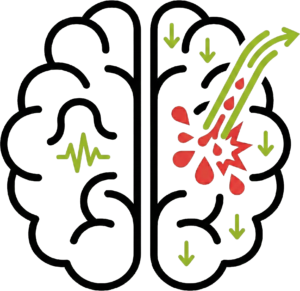
The TIPITCH consortium is committed to creating unprecedented opportunities to develop innovative therapeutic strategies for this devastating type of stroke, with the ambition to radically transform outcomes for patients with Intracerebral Haemorrhage by reducing early mortality and severe disability.
The TIPITCH research programme: a unique opportunity to transform the prognosis of a dramatic disease
Preventing haematoma expansion
Minutes to hours
Facilitating haematoma evacuation
Hours to days
Reducing the oedema that forms around the haematoma
Days to weeks
The RHU TIPITCH is structured around five Work Packages (WP):
Work Packages 1, 2 and 3 focus on scientific and medical innovation. They aim to develop new therapeutic strategies that intervene at each stage of haemorrhagic stroke.
Work Package 4 is dedicated to designing and structuring a specific care pathway for patients with haemorrhagic stroke.
- Work Package 5 is dedicated to project coordination and to the communication and dissemination of the RHU TIPITCH results.
Work package #1
WP1. Preventing Haematoma Expansion
Haematoma expansion affects one third of patients within the first six hours and is the main determinant of poor outcomes in intracerebral haemorrhage. Systemic treatments tested to date (haemostatic agents, blood pressure lowering) have shown limited impact because they do not target the central mechanism: the secondary rupture of perforating arteries caused by mass effect, creating a true “avalanche” phenomenon. Evidence from interventional neuroradiology suggests that temporary, targeted endovascular modulation could stop active bleeding without inducing ischaemia, highlighting the need for a dedicated device.
The objective is to develop an endovascular device capable of locally modulating intracranial blood flow. From preclinical proof‑of‑concept to validation through clinical trials, this work package aims to deliver a new device that will ultimately be submitted for CE marking.
Work package #2
WP2. Promoting Haematoma Evacuation in High Risk Haemorrhagic Populations
Minimally invasive surgery combined with a fibrinolytic agent can accelerate the natural process of haematoma resorption. However, the agents used so far have not allowed sufficient evacuation in 40% of cases and are restricted to patients without haemostatic disorders. Tenecteplase, a genetically modified variant of tPA with an improved safety profile and more targeted fibrinolytic activity, represents a promising alternative.
The objective is to assess the safety and efficacy of tenecteplase using innovative ex vivo clot models that replicate high‑risk haemorrhagic situations. By the end of TIPITCH, the goal is to conduct a randomised controlled trial (RCT) of minimally invasive surgery specifically dedicated to patients at high risk of haemorrhagic complications—patients who have so far been excluded from clinical studies—using tenecteplase as the fibrinolytic agent.
Work package #3
WP3. Reducing Peri haematomal Oedema
Peri haematomal oedema, which develops in the days following a cerebral haemorrhage and significantly worsens functional outcomes, is primarily driven by inflammation. The transcription factor Nrf2, identified as a key regulator in both animal and human studies, offers a promising therapeutic target.
Our objective is to assess whether Diroximel Fumarate—an Nrf2 activator used notably in multiple sclerosis—can reduce the growth of this oedema during the first week after haemorrhage. We will also develop innovative imaging tools to identify patients at highest risk of developing severe oedema.
This study will lay the groundwork for an international phase 3 trial aimed at demonstrating the impact of oedema reduction on recovery. It will also explore new biological and imaging biomarkers to improve patient selection and determine the optimal therapeutic window.
Work package #4
WP4. Structuring the Care Pathway for Patients with Haemorrhagic Stroke
Care for intracerebral haemorrhage has made little progress, as isolated interventions have not significantly improved outcomes. Future advances now rely on proactive, combined, and synchronised strategies that target the entire natural history of the haemorrhage.
The objective is to structure a national network dedicated to developing diagnostic, prognostic, and therapeutic strategies for patients with cerebral haemorrhage. The TIPITCH network will facilitate the progressive implementation of these strategies and support their deployment across the country.
The registry will be observational and multimodal, built on a clinical, radiological, and biological database developed in partnership with patient associations and the FCRIN networks StrokeLink and Tech4Health. Patient‑ and family‑centred communication methods will be integrated to optimise both the quality of outcomes and the support provided throughout the care pathway.
Work package #5
WP5. Coordination, Communication and Dissemination of Results
WP5 plays a central role in the scientific and administrative coordination of the project, as well as in its communication strategy.
Its purpose is to ensure efficient project management by supporting strategic decision‑making in line with the project’s governance, and by guaranteeing operational management aligned with both the scientific and overall strategy. It also oversees the administrative and financial monitoring of the project, ensures compliance with contractual obligations towards the ANR—including timely delivery of project outputs—and manages evaluation and reporting activities. WP5 further supervises the intellectual property strategy covering academic publications and patent licensing to ensure optimal knowledge dissemination.
Finally, it organises internal and external communication activities, which are essential for effective coordination among partners and for strengthening the project’s visibility.
Charlotte Cordonnier, Gaïa Zirka (CHU de Lille)