

Spontaneous intracerebral haemorrhages (also known as haemorrhagic strokes) remain among the most severe forms of stroke, with significant consequences for patients and their families.
In response to this challenge, the French Hospital-University Research (RHU) project TIPITCH has, since 2024, brought together a large community of researchers, clinicians and partners to advance research and improve patient care.
The objective: to better understand, better treat and better support patients at every stage of their journey.
A project structured around four key pillars
TIPITCH is built on several complementary work streams, enabling action at different stages of the disease.
1. Limiting haemorrhage progression
In the early hours, one of the major challenges is to prevent the haematoma (bleeding in the brain) from worsening.
Teams are currently developing innovative miniature devices capable of temporarily modulating blood flow to limit the expansion of bleeding.
These technologies are still at an experimental stage but represent a completely new approach in the management of haemorrhagic stroke.
2. Improving haematoma evacuation
In haemorrhagic stroke, removing the haematoma is often necessary to relieve pressure on the brain.
TIPITCH researchers are developing and testing less invasive approaches, combining minimally invasive surgical techniques with clot-dissolving treatments.
A key aspect is a better understanding of clot composition, enabling treatments to be adapted to each patient.
This approach paves the way for more personalised medicine, particularly for patients on anticoagulants or at increased bleeding risk.
3. Better understanding secondary brain injury
The impact of stroke extends beyond the bleeding itself: surrounding brain tissue is also affected (inflammation, oedema, etc.).
TIPITCH is developing advanced imaging tools (MRI, PET imaging) to:
- better visualise these processes
- understand their consequences
- identify new therapeutic targets
A clinical trial is also underway to test a drug designed to modulate inflammation and limit secondary damage.
4. Placing patients at the heart of research
This is a defining feature of the project. 
- participation in care pathway design
- contribution to research
- improvement of information and support
The goal is clear: to conduct research with patients, not just for them.
A strong collective dynamic
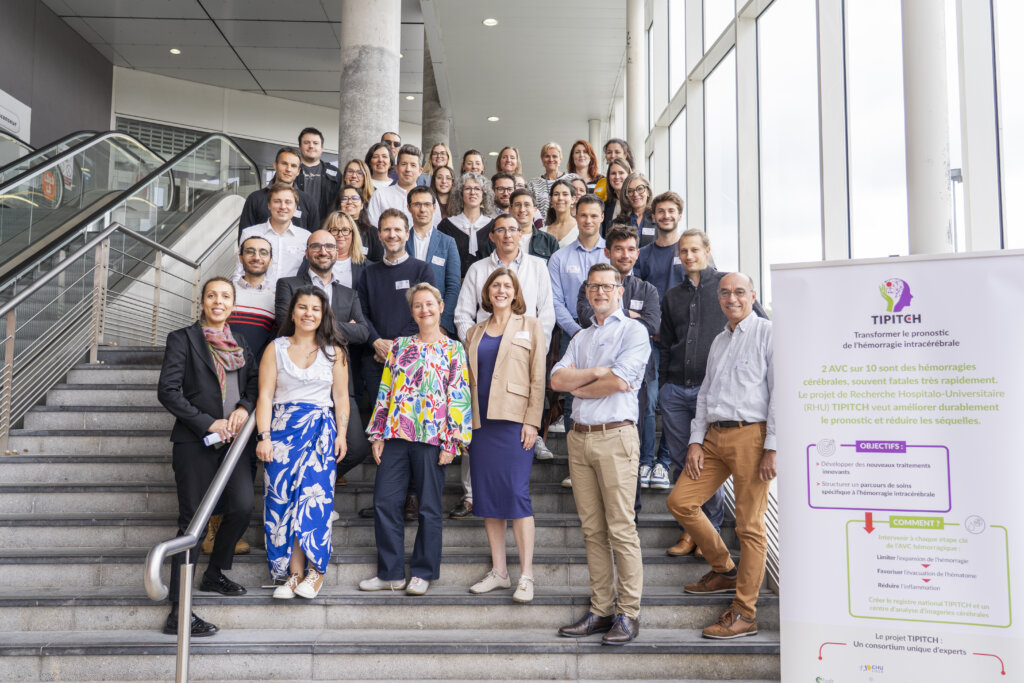
Two years after its launch, TIPITCH is demonstrating a highly positive momentum. At the most recent annual meeting, teams highlighted:
- strong collaboration between centres
- innovation at the core of the project
- increasing programme maturity
Interactions between researchers, clinicians and patients are helping to build a genuine collaborative research ecosystem, focused on delivering practical solutions.
Why does this research matter for patients?
Today, treatment options for haemorrhagic stroke remain limited.
TIPITCH research aims to:
- improve acute-phase treatment
- reduce long-term disability
- adapt management to individual patient profiles
- enhance long-term patient support
Although progress takes time, these advances are essential to achieving more effective and personalised treatments in the future.
TIPITCH represents one of France’s major research efforts in the field of intracerebral haemorrhage.
Thanks to a comprehensive approach — from emergency care to post-stroke follow-up, combining technological innovation and patient involvement — it is opening up concrete perspectives for improving patient management.