

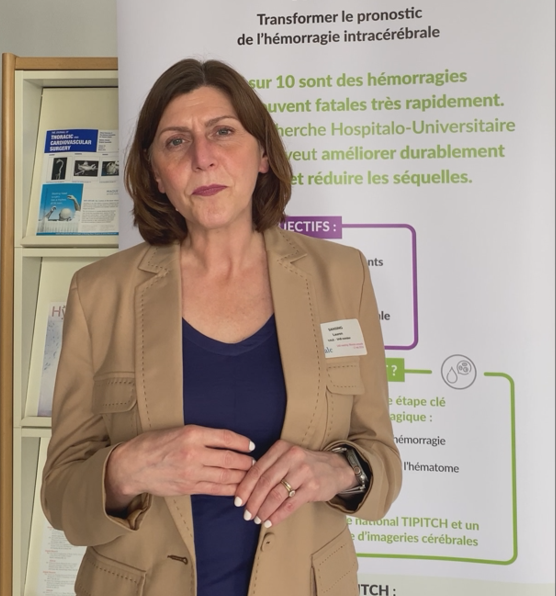
Following the TIPITCH annual meeting held in Lille, we spoke with Prof. Lauren Sansing, neurologist, international expert in stroke, and member of the project’s Scientific Advisory Board. She shares her views on the programme’s progress, strengths and future challenges.
What is your assessment of the work presented within the TIPITCH project?
I was genuinely impressed by all the work presented. What is remarkable is how, in a relatively short period of time, teams from numerous institutions have managed to organise themselves and work together in such a coherent way.
The project addresses intracerebral haemorrhage from several complementary perspectives, focusing in particular on three major challenges:
- early haematoma expansion
- clot dissolution
- secondary brain injury
These are key challenges at the heart of future therapeutic advances in this field. The progress achieved so far is very encouraging. There is a real sense of momentum, strong collective energy and a great deal of creativity driving the research forward.
In your view, what sets TIPITCH apart in the international landscape of haemorrhagic stroke research?
TIPITCH is truly unique in terms of both its breadth and its complementarity.
It covers an exceptionally wide spectrum, ranging from fundamental research, including experimental clot models, through to large-scale national prospective cohorts that enable long-term study of patient outcomes and recovery.
This ability to connect biological mechanisms directly with their clinical application within a single project is extremely rare.
In addition, the project benefits from a highly structured organisation. Teams meet regularly, share results and think collectively about every stage of the process, from pathophysiological mechanisms through to implementation in clinical practice.
To my knowledge, very few projects in the field of intracerebral haemorrhage achieve this level of scientific depth and coordination.
At this stage, what are the main scientific challenges still to be addressed?
One of the major challenges concerns what we refer to as the generalisability of research findings.
In other words: how can we ensure that what is observed in experimental models or clinical trials truly reflects the diversity of situations encountered in real-world patients?
This raises several important questions:
- How can experimental models be designed to accurately reflect clinical reality?
- What inclusion criteria should be used to ensure that clinical trial participants are representative of the patients we aim to help?
- How can we strike the right balance between scientific precision and real-world applicability?
These are critical decisions, and they will be greatly informed by the data generated within TIPITCH.
The establishment of a large national cohort is a major asset in this regard. It will help identify which patients benefit most from different approaches and guide the design of future clinical trials.
If you had to describe TIPITCH in one word?
Ground-breaking.
Through this conversation, Prof. Lauren Sansing highlights the unique nature of RHU TIPITCH: an ambitious, highly structured and deeply collaborative project that is making a tangible contribution to advancing both research and patient care in intracerebral haemorrhage.